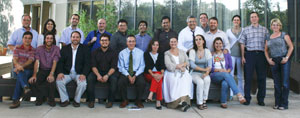
Largest ever return of prestigious European grants for Portuguese life scientists

2010 July 21
Comments Off
by Joana Ferreira

17 July 2010 Instituto Gulbenkian de Ciência (IGC)

http://www.alphagalileo.org/ViewItem.aspx?ItemId=81455&CultureCode=en

 Five young group leaders in Portugal have just joined the prestigious network of recipients of the European Research Council Starting Grants, in what is the largest yield to date for Portuguese researchers in this prestigious and highly competitive funding programme. Each researcher thus ensures funding on the order of 1-1.5 million euro, for a period of five years, which will allow them to further unravel processes and molecules underlying the division, movement and ageing of cells, inflammatory responses to disease and adaptation of bacteria to the environment.

Isabel Gordo, Mónica Bettencourt-Dias and Teresa Teixeira are group leaders at the Instituto Gulbenkian de Ciência, just outside Lisbon. Helder Maiato is at the Instituto de Biologia Molecular e Celular, in Porto, and Bruno Santos Silva is based at the Instituto de Medicina Molecular, in Lisbon. They are all in their 30s, set up their own research groups in Portugal within the last 4-6 years, and except for Teresa Teixeira, are all alumni of the Gulbenkian PhD Programme in Biology and Medicine.

Mónica Bettencourt-Dias, Helder Maiato and Teresa Teixeira are interested in different aspects of the process whereby cells divide. Their findings could have implications for understanding the causes of cancer, age-related syndromes and infertility.

Bettencourt-Dias will be investigating further how the number and architecture of structures called centrioles are regulated in different cells. Centrioles are essential during cell division for the proper separation of chromosomes, and also in motile cells (such as sperm and certain parasites).

Maiato will build on techniques and results already accumulated by his young research group to dissect out the function of yet another crucial keg in the cell division machinery – the kinetochore, which attaches the chromosomes to the protein tracks (microtubules) along which they migrate to the poles of the cell, just before it divides to give two daughter cells.

Teixeira, on the other hand, will be looking into the cellular clock that counts the number of generations. Telomeres are stretches of DNA found at the ends of chromosomes in eukaryotic cells (such as human cells), that shorten with each cell division. With this funding, Teixeira will be able to study individual telomeres, to investigate the impact of structural changes on the capacity of cells to proliferate.

Bruno Silva Santos is an immunologist, and this ERC Grant will be used to identify the molecules and processes underlying the inflammatory responses mediated by T cells of the immune system in response to an infection (by the malaria parasite Plasmodium, for example). His findings may impact on the development of new or more efficient vaccines for chronic infections, such as malaria and tuberculosis.

Isabel Gordo’s winning proposal is to provide insight into a pivotal question for evolutionary biologists – the process of adaptation, on which natural selection, and evolution, rest. Gordo will work with populations of the bacteria Escherichia coli, to better understand the biology of bacteria, their diversity, how they evolve and adapt to new environments, namely the selective pressure put on them by the immune system.

The ERC Starting Grants aim to support early career independent researchers (with two to ten years’ research experience since completion of their PhD), with a promising scientific track record and proposing to carry out an ambitious and ground-breaking research proposal. The main selection criteria for these, and other, ERC awards is scientific excellence, and all areas of research are covered in the funding scheme. In the previous two rounds, researchers in Portugal secured four Starting grants in the Life Sciences: two in 2008, by researchers at the IMM, and two in 2009, by researchers at the IGC.

 About the new grantholders:

Mónica Bettencourt-Dias, age 37, heads the Cell Cycle Regulation laboratory at the Instituto Gulbenkian de Ciência (IGC), just outside Lisbon. Educated at the University of Lisbon, with a degree in Biochemistry, she received her PhD in cardiac regeneration from University College London (UK). After post-doctoral research at Cambridge University, she moved to the IGC, in 2006, to set up her own research group. She has a post-graduate diploma in Science Communication from Birkbeck College (UK). Her group has published several important papers in the field of cell division and motility, and she has received several prizes and grants, including the Eppendorf Prize, the Pfizer Award, an EMBO Installation Grant, the EMBO Young Investigator Award and, most recently, a grant of the Harvard Medical School-Portugal Programme.

Hélder Maiato, age 34, is the head of the Chromosome Instability and Dynamics laboratory at the Instituto de Biologia Molecular e Celular (IBMC) and a faculty member of the Faculdade de Medicina da Universidade do Porto (Porto). Maiato has a degree in Biochemistry from the University of Porto and a PhD in Biomedical Sciences from the same university, having done most of his doctoral research at the University of Edinburgh (UK). He was a post-doctoral researcher at the Wadsworth Center, Divison of Molecular Medicine, New York State Department of Health (USA) where he applied laser microsurgery techniques to investigate the cell division process. Maiato has over 25 publications in leading scientific journals such as Cell, Nature Cell Biology and The Journal of Cell Biology, has and received several awards and grants, including a Human Frontier Young Investigator Grant.

Teresa Teixeira, 38 years old, was an undergraduate and doctoral student in Paris, France. After receiving her PhD in nuclear organisation and functional genome analysis of Saccharomyces cerevisiae from the Pasteur Institute, she moved to the Institut Suisse de Recherche Expérimentale sur le Cancer, in Lausanne. In 2005 she joined the CNRS in Lyon, with a permanent position. She is setting up her own research group at the Institut de Biologie Physico-Chimique, in Paris, having initially applied for ERC funding through the IGC where Teixeira initially planned to establish herself as an independent group leader.

Bruno Silva-Santos, age 36, is head of the Immunology Unit at the Instituto de Medicina Molecular and a faculty member of the Faculdade de Medicina de Lisboa. He is also an External Researcher of the IGC. Silva-Santos has a degree in Biochemistry from the University of Lisbon, and a PhD in Immunology from University College London (UK). He was a post-doctoral researcher at King’s College London (UK), before returning to Portugal, in 2005. He has published in leading scientific journals, such as Nature Immunology, Nature and Science, and received several prizes and grants, including the King’s College London Young Researcher of the Year Award, an EMBO Installation Grant, the Pfizer Award for Clinical Research and the International Cytokine Society prize for young researcher.

Isabel Gordo, 37 years old, has a degree in Physics from the Instituto Superior Técnico (Lisbon), a PhD in Evolutionary Biology from the University of Edinburgh (UK). Since 2004 she has been head of the Evolutionary Biology group at the IGC. She has over 25 publications in leading scientific journals, has supervised several PhD students and collaborates with several research groups in Portugal and abroad.


University of Algarve (CRIA) intern completes tech assessments during U.S. internship

2010 June 15
Comments Off
by utenstaff

Alexandra Marques of the University of Algarve’s TTO (CRIA) recently completed a two-month internship with Christine Burke at South Texas Technology Management. Alexandra also performed a technology and market assessment of Additive for Solefish Food. She worked with Cliff Zintgraff, UTEN Austin program manager, and conducted two steps.

First, a four- to eight-hour RapidScreen to assess categories of readiness related to the technology, technology team, institution, and market. RapidScreen evaluates both the technology and the infrastructure required to advance commercialization. Second, a 40- to 60-hour MarketLook assessment of the market size and opportunity with a focus on the U.S. market. MarketLook’s goal is to uncover the market’s voice with respect to the technology. By uncovering this voice, the TTO can work with the inventor to negotiate a license; form a spin-off; create research, development, and sales collaborations; and/or address shortcomings that are barriers to market acceptance. The MarketLook process uses as its main research method primary interviews (phone calls, in-person interviews, and email exchanges) with potential customers, end users, partners, and other expert validators in the technology’s target markets.

Cliff Zintgraff standing with Alexandra Marques

Cliff Zintgraff, UTEN Austin program manager, and Alexandra Marques, CRIA, University of Algarve.

The assessment process yielded a number of useful lessons.

RapidScreen

  1. A good technology description and good Internet research can lead to strong initial primary interviews. The first interview was two degrees, or hops, from a deep expert in the field.
  2. Corollary to #1 – university researchers make good first interviewees. They are willing to talk and share and can inform about industry possibilities.
  3. Complex ownership arrangements involving multiple institutions should be documented in writing and readily accessible.

MarketLook

  1. Good interviews can help you know rapidly if a market exists or not. We knew within three calls that there is no solefish industry in the U.S. However, we did learn of several flounder producers. The inventor told us that flounder could be positively affected by the additive.
  2. Opinions can change radically with just one hop in the value chain. Aquaculture managers and fish behavior researchers immediately saw the potential value in the technology. Fish nutritionists saw the potential challenges!
  3. The MarketLook process created two opportunities for collaboration, a confirmation that an assessment-oriented (as opposed to sales-oriented) process can lead to collaboration opportunities.

Impact on TTO Practices

As a result of this UTEN training, CRIA is implementing the following procedures in its operations.

  1. Technology ranking and stages: CRIA is implementing a process to rank technologies and identify their stages of development. This process will be used to set priorities and identify appropriate next steps for priority technologies.
  2. Central collection of analysis data: Processes will be defined such that technology analysis results in the central collection of analysis data for efficient execution of processes.
  3. Clarify needs of research and industrial markets around UAlg technologies: UAlg will apply processes that rapidly expose the market interest in UAlg technologies. The processes will work to view the technology from the market’s perspective. The goal of the process is to see all options for a technology and develop alternatives that may go beyond initial researcher expectations and intent.
  4. Identify specific potential collaborations: Beyond overall market understanding, processes will be defined to identify and pursue specific licensing and other opportunities for UAlg technologies.

UTEN conducts one week of in-situation training at FCT/UNL

2010 June 15
Comments Off
by utenstaff

Cliff Zintgraff, UTEN Austin program manager, visited FCT/UNL for in-situation training from May 17 to 21, 2010. Dina Chaves, TT coordinator for the FCT/UNL Office for Entrepreneurship Promotion and Technology Transfer hosted Cliff. The purpose of UTEN in-situation training is to transfer lessons learned in the UTEN program into operational practices in Portuguese technology-transfer offices. This is accomplished by assessing the needs of each office, reviewing the UTEN training received by TT office staff, and developing a customized plan within the overall framework of the training.

A UTEN Austin staff member leads the training. Additional subject matter experts and technology-transfer practitioners provide support either on-site or remotely. The goal of in-situation training is to benefit offices long-term by improving business practices and procedures. During in-situation training at FCT/UNL, Cliff and Dina developed a specification for the FCT/UNL TTO web site. It helped cast a vision for how the office interfaces with its main customers: industry, researchers, students, and entrepreneurs. They developed an overall procedural flowchart. It focused on disclosure-to-patent decisions and defined how UTEN assessment tools would incorporate with the process. It described the functions UTEN assessment tools would serve. They also developed a disclosure form appropriate for FCT/UNL. It struck a balance between information disclosure and simplicity-of-use for inventors. During the week, Dina and Cliff advanced U.S. connections for select FCT/UNL technologies. Cliff and Dina were key to the FCT/UNL Office for Entrepreneurship Promotion and Technology Transfer web site going live with its initial public portfolio offering.

Dina Chaves standing with Susana Barreiros and Cliff Zintgraff

L-R: Dina Chaves, TT coordinator for the FCT/UNL Office for Entrepreneurship Promotion and Technology Transfer, Susana Barreiros, professor and subdirector, FCT/UNL, and Cliff Zintgraff, UTEN Austin program manager.

“Cliff provided the expertise needed to develop TTO’s procedures in order to optimize technology commercialization in collaboration with OTC (Office of Technology Commercialization) at UT Austin,” Dina Chaves said. “The outcome of UTEN support allows the development of best practices in technology scanning and screening activities, improving the effective interaction between the TTO and the stakeholders. Cliff and UTEN Austin’s collaboration is crucial to achieve the mission of the FCT/UNL TTO: Turning ideas into assets through the commercialization of technologies.”

According to Susana Barreiros, professor and subdirector, FCT/UNL, “The partnership with UT Austin provides many opportunities to improve the knowledge-transfer process at FCT/UNL. One recent example is the design of the FCT/UNL TTO web site, which will help clarify IP policy and procedures and will undoubtedly foster a culture of innovation and entrepreneurship among the FCT/UNL community.” UTEN will publish a case study of the effort, including a procedural flowchart and a disclosure form. Find this and other case studies at www.utenportugal.org/case-studies.

UTEN Portugal and Carnegie Mellon Portugal promote workshop on technology transfer

2010 June 15
Comments Off
by utenstaff

The UTEN Portugal Network and the Carnegie Mellon Portugal Program co-organized “Corporate Partnering to Facilitate University Commercialization Activities,” a workshop at the Faculty of Economics and Management, Catholic University of Portugal, in Lisbon, on June 15 and 16, 2010. Several experts from Carnegie Mellon University (CMU) participated. The workshop’s main objectives included:

  • enable the discussion of good practices and the most effective ways to establish partnerships between the universities and companies
  • aim to attract new business partners and thus promote the commercialization of innovation and technology.

Some of the themes discussed at the event included the:

  • strategic partnership between the universities and companies
  • promotion of a continuous bond between the university and its alumni
  • intellectual property rights and the consequent advantages that may come from a partnership between the parties involved in the process.

José Mendonça, scientific director of UTEN Portugal, considers “the development and improvement of competencies in technology transfer and commercialization are nowadays crucial for the entities within the national scientific and technological system, namely for the scientific and/or higher-education institutions, technology-based business incubators, and science and technology parks. In this context, the relationship with companies’ [Industrial Liaison Offices] play an increasingly important and relevant role. This is why UTEN Portugal is paying special attention, in 2010, to the development and improvement of competencies in these areas — so as to promote more effective partnerships between the universities and companies. [This] will lead to an economic valorization of investments in research and technological development.” João Barros, national director of the Carnegie Mellon Portugal program, stated that “the strategic partnership with Carnegie Mellon offers the opportunity to get in touch with the best practices of the top North-American universities. This way, making it possible to speed up innovation processes within the Portuguese academic and business contexts.”

Carnegie Mellon University’s experts presented CMU’s technology-transfer model. It is considered one of the best in this area with a particular emphasis on the establishment of strategic partnerships. Experts included Bill Swisher, acting senior director, Corporate and Foundation Relations; Tara Branstad, associate director of the Center for Technology Transfer and Enterprise Creation (CTTEC); Gene Hambrick, corporate relations director at Cylab (Cyber Security Training and Research Centre, established at CMU, which works together with several organisms and companies in the United States); and Aamir Anwar, director of international alumni relations at CMU. Hyong Kim, an electrical and computer engineering professor at CMU, delivered the keynote speech. The speech addressed upcoming information and telecommunication-technologies challenges not only at the market level but also at the level of universities’ main research topics. Debate sessions and hands-on analysis of real case studies filled the two-day workshop. Participants discussed several questions relevant to the Portuguese universities and the research and technology sector. Topics also included models, solutions, and proposals successfully implemented in the U.S., namely at CMU.

Sofia Vairinho and Hugo Barros discuss their UTEN internship experiences at CMU

2010 June 2
Comments Off
by mguentzel

“Through the UTEN program, from FCT, my insertion on a Professional Development Program at Carnegie Mellon University (CTTEC and CMU General Counsel) from 29 March till 25 April, represented a unique opportunity to contact, in a labor context, with the legal procedures and methods regarding the use and implementations of intellectual property, technology transfer and commercialization strategies. Thanking to all the great “Professional Teachers” at CMU the goal of my professional development program was achieved and a new step was given on the implementation of new methodologies regarding the knowledge development and a new era for enterprises creation.” -Sofia Vairinho

Sofia Vairinho

Sofia Vairinho

“The professional development program, developed at the Centre for Technology Transfer and Enterprise Creation (CTTEC) of Carnegie Mellon University (CMU) from March 1st to April 23rd, aimed to the development and consolidation of competences in technology licensing and commercialization, as well as benchmarking good practices on entrepreneurship and technology transfer from CMU and from the Pittsburgh region. The professional development program was an amazing opportunity to learn and share experiences with some extraordinary individuals and institutions in one of the best Universities in the world, as well as to develop a network of international contacts.” -Hugo Barros

Hugo Barros

Hugo Barros

March UTEN Workshop on University Spin-outs

2010 April 30
Comments Off
by Joana Ferreira

In March, UTEN held a workshop on university spin-outs and models for venture creation featuring Brett Corn­well- Director of Commercialization Services for the Tex­as A&M University System, Professor of Technology Com­mercialization at the IC2 Institute at the University of Texas, and former Technology Commercialization Spe­cialist for NASA. Ana Paula Amorim- UTEN Liaison, Maria Jose Francisco- UTEN Portugal Program Manager, and Eli D. Mercer- UTEN Austin Program Manager for Training and Internships represented the UTEN Team. We would like to thank the 22 technology transfer professionals from across Portugal who attended the sessions (includ­ing licensing professionals, entrepreneurship advisors, and incubator managers) for an excellent exchange of ideas. The New University of Lisbon (UNL) graciously hosted the event. Our special thanks to UNL and espe­cially to Dina Chaves, UTEN Austin intern in 2009.

WORKSHOP AGENDA:

Day 1:

Morning- Brett introduced the “why do we exist and what are we trying to accomplish” discussion. Partici­pants were challenged to consider goals, impact, and role within the university ecosystem.

Afternoon- Brett introduced the key concepts of the pre-reading materials regarding OTC best practices, and began to describe his vision for “taking your OTC from an appendix to the heart of the university”. Par­ticipants were challenged to consider what role they currently play, where they would like to go as an office, and how they might get there.

Day 2:

Morning- Brett Described the A&M philosophy, model, and matrix for technology classification, which links di­rectly to the A&M methodology for making informed de­cisions regarding path-to-market, venture vs. licensing focus, resource allocation, etc.

Afternoon- Eli introduced the topic of business intelli­gence/competitive intelligence as a tool for decision-making and support using the A&M model and meth­odology as an effective example, then presented, compared, and contrasted three tools used in IC2 and partner OTC’s:

1. The UT OTC Methodology

2. The Quicklook Methodology

3. The Rapid Screen Methodology

Participants were challenged to consider ways their of­fices could formalize decision-making processes, and to form teams and map technologies using Brett’s matrix and approach.

Day 3:

Morning- Eli introduced his methodology and approach to creating a data grid for team intelligence gather­ing. Participants were challenged to consider ways to incorporate some form of data mapping into their pro­cesses, and to map technologies on Brett’s matrix based on their evaluations.

Afternoon- Participants shared presentations and con­clusions from the A&M approach, and the context with­in their ecosystems. Brett and the UTEN team provided feedback and the group discussed ways to leverage lessons shared to successfully achieve commercial­ization goals through effective venture creation tech­niques and careful selection of technologies for univer­sity spin-outs.

UTAD Intern Completes Tech Assessments During U.S. Internship

2010 April 30
Comments Off
by Joana Ferreira

Carla Mascarenhas of UTAD recently completed a two-month U.S.-based internship with Sean Thompson at South Texas Technology Management (http://www.utsystem.edu/sttm/index.shtml). Also during her two-month internship, Carla performed a technology and market assessment of New Agglomerant for Wood Particles working with Cliff Zintgraff, Program Manager from UTEN UT-Austin. Two steps were performed. In the first, a 4-8 hour RapidScreen was performed to as­sess categories of readiness related to the technology, technology team, in­stitution, and market. The RapidScreen identifies issues in the readiness of the technology, institution, or team to move forward with the technology, evalu­ating both the technology, and also the infrastructure required to advance commercialization. The second step, the MarketLook, was a 40 to 60 hour assessment of the market size and opportunity, with a focus on the U.S. market. The goal of this step is to uncover the “voice of the market” with respect to the technology, so that the TTO can work with the inventor to negotiate a license, form a spin-off, cre­ate research, development and sales collaborations, and/or address shortcomings that are barriers to market acceptance. The MarketLook process uses as its main research method primary interviews (phone calls, in-per­son interviews, and email exchanges) with potential cus­tomers, end users, partners and other expert validators in the technology’s target market/s.

The RapidScreen assessment results were generally positive, characterizing a good infrastructure to support commercialization efforts, but there were surprising find­ings regarding existing agreements that led to a strategy review. Using the technology description developed and techniques trained during the in­ternship, three core market interviews were secured, including one with the Director of Technology for a large wood products manufacturer, an in­dustry association Certification Direc­tor, and a prolific industry journalist. These interviews defined in great de­tail exactly how the market views the technology and what characteristics of the technology matter most.

Carla will be taking these lessons back to UTAD: “With the RapidScreen and MarketLook and UTEN training, re­garding the technology in study, we were able to see the very real need for a product like New Agglomerant for Wood Particles in the market. We also learned that our office and our researcher still have work to do to be successful in the market, especially with respect to understanding the cost of production, and the prices we can expect the market to pay. We will need to do these things in order to have a more concrete answer from the companies we contacted, especially from one company in particu­lar who showed real interest in our technology. Over­all, the tools and lessons learned will help the UTAD TTO make better choices about the technologies to pursue for commercialization. Since the RapidScreen uncovers the status of the technology and research team support, and the MarketLook uncovers the market’s opinion of the technology, these two methodologies are very use­ful when we want to extend patent protection to PCT or European Patents.”

Cloudviews cloud computing conference in Porto

2010 April 30
Comments Off
by Joana Ferreira

The CloudViews 2010 conference will convene IT professionals, researchers, and service providers in the cloud computing field. Organized by EuroCloud Portugal, CloudViews 2010 is the second annual edition of the conference. This year’s theme is the “Cloud Ecosystem” and discussion topics will include:

  • Cloud elasticity
  • Cloud computing platforms interoperability
  • Data management
  • IT departments and cloud computing integration
  • User perspective – how Internet (the cloud) will become our PC
  • Encryption and security technologies
  • Predictability and provision platforms
  • SLAs monitoring and agreements contracts
  • Elastic networks
  • Companies and startup opportunities – how to become a cloud computing provider and how to use cloud computing to add (real) value to business
    • The deadline for submitting paper proposals is 15 April, 2010. For more information, please see: http://2010.cloudviews.org/site/

      Bruce Pennycook (UT Austin) presented at GEAR: Sound & Interactive Media

      2010 April 30
      Comments Off
      by Joana Ferreira

      Bruce Pennycook has participated at Gear: Sound & Interactive media as a presenter. The event, which took place at Universidade da Beira Interior, in Covilhã, joined researchers, musicians, artists, research centers and companies connected to the interactive media from such countries as the United States, United Kingdom, The Netherlands, Japan and Portugal.

      Gear was a 5 day event with conferences and workshops during the day and project presentations and multimedia concerts at night. Pennycook presented on April 7th together with names like Jade Walker (USA), Teresa Dilon (IRL, UK, PT) and Roger B. Dannenberg (USA) among others. This event also saw presentations of some of the main multimedia design companies in Portugal, like YDreams, Near Interaction, Edigma and CriativeBitBox.

      Mónica Mendes (PhD student in Digital Media) visits UT Austin and SXSW

      2010 April 30
      Comments Off
      by Joana Ferreira

      Visiting the University of Texas and attending the South by Southwest in Austin was a very intense experience, worth every moment! Time was the only scarce resource, indeed. The whole schedule of this prospective visit was gratefully intensive. Meeting with the UT faculty and researchers at the Communication College and the School of Information provided valuable feedback and recommendations on my research project.

      The fascinating Radio-Television- Film department was unveiled through a comprehensive tour on the subjects and facilities offered to the students. I was also given the opportunity to visit the Videoranch 3D studios during a live performance with 3D scenery and avatars, and all the emotion of real-time!

      There was a welcome evening, a wonderful get together to meet with UT researchers and Portuguese fellows in Austin, and it also was really nice to be part of the UT audience when our Portuguese fellows performed at the AMODA digital showcase.

      The SXSW festival was another acquaintance from this awesome experience: sleepless nights/ days overtaken by compelling references at the conferences, workshops and networking during the interactive week, and also from the music field – an insane adventure worth the try!

      Plans for the future naturally triggered from this visit, including ideas for workshops in video effects and optimization for real-time processing, as well as on directing and editing a trailer.

      Austin is a simultaneously quiet and raving spacious city with an inspiring environment, and many, many trees – an enchanting setup for the RTiVISS research, and with interesting resources for the interactive installations in progress.

      I’m looking forward to coming back, hopefully to work on film, real-time video and usability issues at UT, and also regarding a panel proposal focusing on real-time video in digital environments for the next SXSW Interactive.

      To share this experience, I’ve posted at the research blog http://www.rtiviss.com/ and linked to the UT Austin

      www.flickr.com/groups/utportugal where you can also add your comments or ask any further specificities.

      By Mónica Mendes